Verified Attendees
Exhibiting Companies
Accuracy
Delivery Time
Verification Layers
These are companies that make golf clubs, drivers, putters, golf balls, and other gear for retailers, golf pros, and players.
These brands provide golf clothing, performance shoes, gloves, outerwear, and accessories to golf retailers and sporting goods stores.
These companies offer golf simulators, launch monitors, swing-analysis systems, and digital tools to support training and performance.
Suppliers of putting aids, swing trainers, practice equipment, and golf fitness products designed to improve player performance.
These businesses offer golf course software, tee-time booking systems, management tools, and other solutions for golf clubs.
These suppliers provide golf bags, grips, headcovers, travel cases, maintenance products, and accessories for golf shops and retailers.
Retail buyers sourcing golf equipment, apparel, and accessories for pro shops, sporting goods stores, and golf retail businesses.
Golf professionals and instructors exploring new equipment, club-fitting solutions, training aids, and technologies to develop players.
Golf course owners and managers seeking equipment for operations, maintenance solutions, management software, and facility improvement products.
Get in touch with the directors of parts, the service managers, the leaders of rental operations, the maintenance professionals, and the specialists in the aftermarket business.
Distributors and wholesalers sourcing golf products, evaluating manufacturers, and developing supplier relationships for their target markets.
Industry specialists researching golf technology, performance-tracking systems, product innovation, and advanced equipment solutions.
It is important to identify retail buyers, pro shop operators, and distributors who are relevant to golf clubs, balls, bags, and other playing equipment, so that suppliers can direct their prospecting efforts towards businesses that match their product lines.
Research companies and professionals involved in golf apparel, performance footwear, gloves, and accessories. Information about these businesses can be of use when carrying out market research, planning distribution, and developing retail partnerships.
Look through potential business customers for golf simulators, launch monitors, swing-analysis systems, and digital training solutions. By grouping potential customers according to the technology that interests them, companies can identify commercial opportunities that are relevant to them.
Look for golf courses, clubs, resorts, and facility management companies that might have needs relating to operational products and services. This method lets suppliers focus on organizations whose requirements match their offerings.
Research manufacturers, wholesalers, retailers, and service providers operating across the golf supply chain. This can support supplier discovery, partnership research, and regional distribution planning.
Group the prospect research according to company category, professional role, geography, and business function. When you carry out focused segmentation, it will enable the marketing and sales teams to create more relevant messaging for various audiences in the golf industry.
Exploring past and upcoming PGA Show editions can help businesses understand changes in golf equipment, apparel, technology, retail solutions, and professional education.
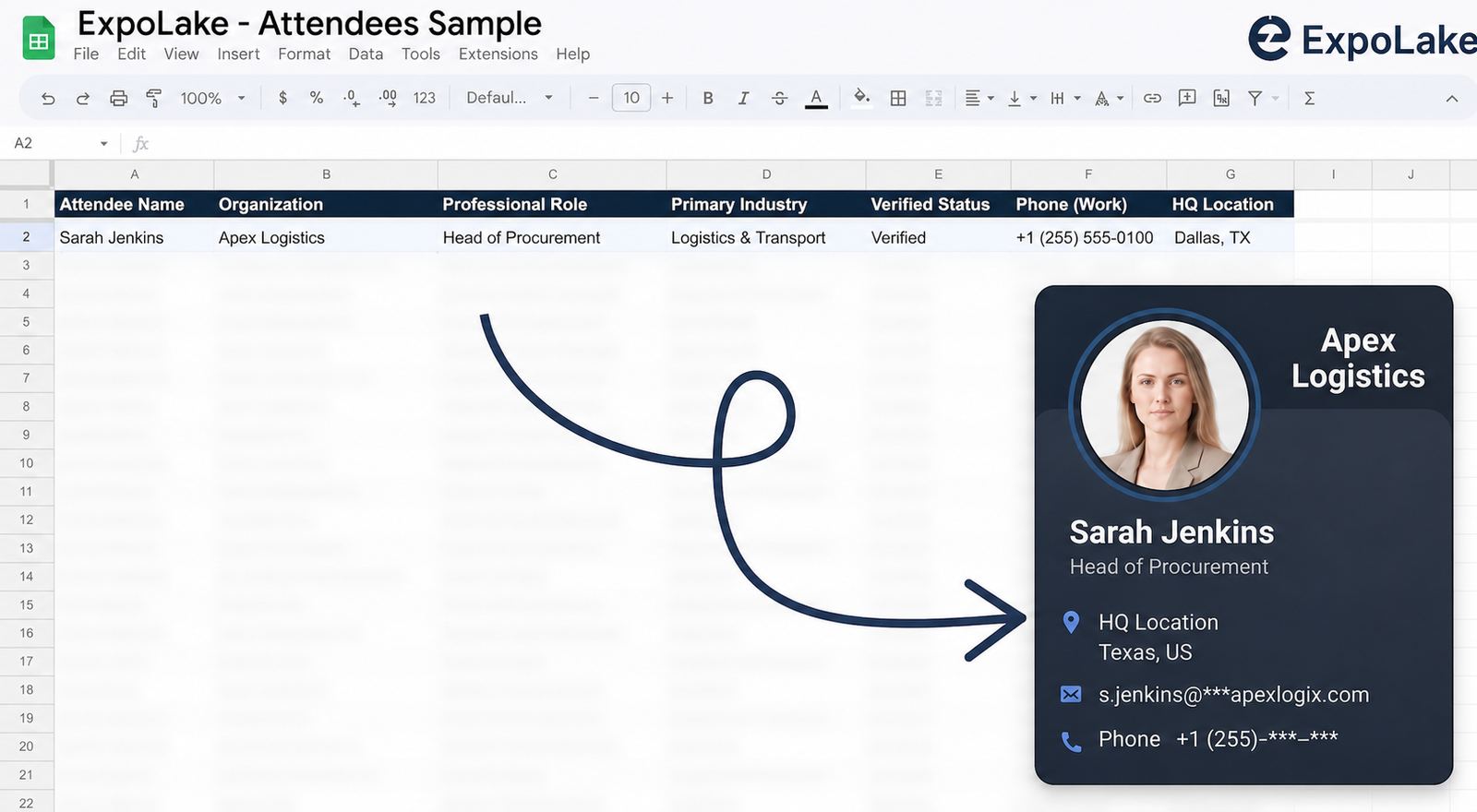
A sample of PGA Show-related contacts can help businesses understand what company and professional information may be available in an industry-focused directory. Depending on data availability, sample records may include company names, business websites, professional names, job titles, business contact details, geographic information, and golf industry classifications.
The prospect research carried out by ExpoLeads is organised according to various segments of the golf industry, such as equipment, apparel, accessories, technology, and golf facility services. This helps companies find prospects that match their products or services.
Since different professionals in the golf industry have different duties and purchasing priorities, it is possible to divide prospects on the basis of their job title and business role in order to carry out more appropriate sales and marketing activities.
Golf companies can conduct research by customer area, based on product categories such as clubs, footwear, training aids, simulation systems, and course management solutions. Focusing on products helps to identify the target audience group that has commercial relevance.
Where geographic data is available, it can be used by businesses to group their prospects according to country, state, or city; this in turn helps with regional sales planning, research into distributors, and expanding into new golf markets.
Manufacturers, wholesalers, retailers, and service providers may use information about their own companies to investigate possible partners throughout the golf supply chain, helping businesses when assessing distribution relationships and new commercial channels.
Since different companies need different kinds of prospect information, businesses are able to compare directories with their intended sectors, professional positions, company profiles, and their business development goals.
Every contact in the ExpoLake database goes through a structured, multi-step sourcing and verification process before it reaches your team. Here is how we build data you can trust.
Contacts are gathered from trade shows, global directories, e-books, newsletters, and digital publications spanning dozens of industries and regions.
Machine learning fills missing fields, appends firmographic data, and segments contacts by industry, role, company size, and intent signals — automatically.
Every record is cross-checked against our master database and validated via social platforms, public registries, and news sources to confirm authenticity.
Anomalies, duplicates, and stale entries are flagged using statistical models and eliminated. A final manual audit ensures the highest standard of data quality.
A/B-tested opt-in email sequences are deployed to capture and confirm explicit consent, fully aligned with GDPR, CAN-SPAM, and CASL compliance frameworks.
A final tele-verification call confirms all data fields. Only fully validated, consented records are released to the client — clean, compliant, and ready to use.